Science and Food
  • Home
  • Public Events
    • Video Gallery
    • 2022 People, Food, & Climate
    • 2019 Food Waste
    • 2017 Future of Food
    • 2016 Public Lecture Series
    • 2014 Public Lecture Series
    • 2013 Public Lecture series
    • 2012 Public Lecture Series
  • Future Food Fellows
  • Building Community
  • Course
  • Press
  • Support Us
  • Contact Us
  • Click to open the search input field Click to open the search input field Search
  • Menu Menu
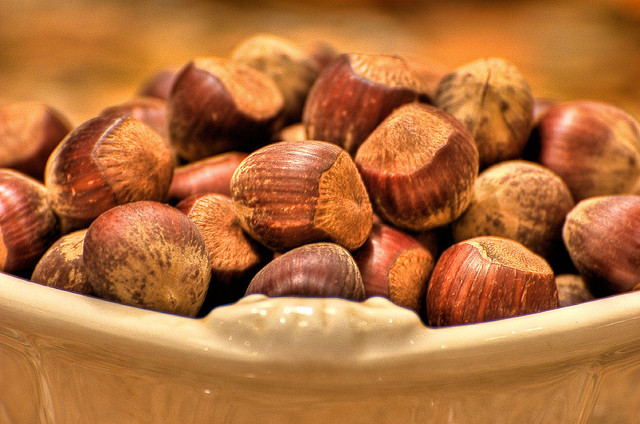
Photo credit: Chris Battaglia (photog63/Flickr)

Hazelnut

January 14, 2014/in Flavor of the Month/by Grant Alkin

Photo credit: Chris Battaglia (photog63/Flickr)

Hazelnuts may not be as popular as other nuts in the U.S., but they have quite the culinary versatility, enjoyed in pralines, Nutella, and even as themselves. These nuts grow on hazel trees, of the genus Corylus. Depending on the plant species and nut shape, hazelnut also refers to the filbert nut or cobnut. Filbert nuts have an elongated shape that tapers into a “beak”, and are found on the Filbert (C. maxima), Colchican Filbert (C. colchica), and Turkish Hazel (C. colurna). Cobnuts are generally rounder, and grow on the American Hazelnut (C. americana) and the more commercially recognized Common Hazel (C. avellana) [1].

Whether in the form of a nut, essence, or oil, hazelnuts owe their sweet, buttery flavor profile to the molecule filbertone. Interestingly, filbertone can be used to test for the authenticity of olive oil. Olive oils are sometimes cheapened by mixing in hazelnut oil [2]. As filbertone is one of the components of hazelnut oil, testing for its presence can determine whether or not a sample of olive oil is impure [3]. Although hazelnut oil is less expensive compared to olive oil, it has a strong, robust flavor that makes it a great substitute in salad dressings and baked goods.

Filbertone_Hazelnut-02

Like many nuts, hazelnuts are a good source of protein and monounsaturated fats. Further, they contain a significant amount of thiamine, various B vitamins, and especially vitamin E [4]. Need another reason to try out hazelnuts this month? The warm, rich, velvety taste of roasted hazelnuts in decadent truffles or comforting lattes has a way of slowing down time. Try it for yourself.


References Cited

  1. Flora of North America: Corylus. <http://www.efloras.org/florataxon.aspx?flora_id=1&taxon_id=108088>
  2. Arlorio M.; Coisson JD; Bordiga M.; Garino C.; et al. “Olive Oil Adulterated with Hazelnut Oils: Simulation to Identify Possible Risks to Allergic Consumers.” Food Addit Contam Part A Chem Anal Control Expo Risk Assess. 2010 Jan; 27(1):11-8. doi: 10.1080/02652030903225799.
  3. Flores, G.; Ruiz del Castillo, M.L.; Blanch, G.P.; Herraiz, M. “Detection of the Adulteration of Olive Oils by Solid Phase Microextraction and Multidimensional Gas Chromatography”. Food Chemistry, 2006 Jul; 97(2): 336–342.
  4. Nutritional Value of Hazelnuts. < http://www.aboutnuts.com/en/encyclopedia/hazelnuts>

Alice PhungAbout the author: Alice Phung once had her sights set on an English degree, but eventually switched over to chemistry and hasn’t looked back since.

Read more by Alice Phung


Tags: chemistry, filbertone, flavor, hazelnut, molecule, nutella, nutrition, olive oil
Share this entry
  • Share on Facebook
  • Share on X
  • Share on Pinterest
  • Share on LinkedIn
  • Share on Tumblr
  • Share on Vk
  • Share on Reddit
  • Share by Mail
https://www.scienceandfood.org/wp-content/uploads/sites/123/2014/01/hazlenuts_photog63_flickr.jpg 424 640 Grant Alkin https://sites.lifesci.ucla.edu/ibp-scienceandfoodnew/wp-content/uploads/sites/123/2016/09/newlogoSm-2-300x31.png Grant Alkin2014-01-14 10:00:182014-01-14 10:00:18Hazelnut
You might also like
A Matter of Taste: Full-Fat Versus Reduced-Fat Cheese
Beer Yeast & Flavor
Nutmeg
Brownie Hacks & Cookie Engineering
Saffron
The Molecules of Food and Nutrition
Fancy Chocolate Treats
Caramel
Search Search

Recent Posts

  • Hello world!
  • Hello world!
  • Hello world!
  • Aquafaba Meringues
  • Vertical Farming & Micro-Gardening

Archives

  • March 2017
  • November 2016
  • August 2016
  • May 2016
  • April 2016
  • March 2016
  • February 2016
  • January 2016
  • December 2015
  • November 2015
  • October 2015
  • September 2015
  • August 2015
  • July 2015
  • June 2015
  • May 2015
  • April 2015
  • March 2015
  • February 2015
  • January 2015
  • December 2014
  • November 2014
  • October 2014
  • September 2014
  • August 2014
  • July 2014
  • June 2014
  • May 2014
  • April 2014
  • March 2014
  • February 2014
  • January 2014
  • December 2013
  • November 2013
  • October 2013
  • September 2013
  • August 2013
  • July 2013
  • June 2013
  • May 2013
  • April 2013
  • March 2013
  • February 2013
  • January 2013
  • June 2012
  • May 2012
  • April 2012

Categories

  • Contests
  • Course Lectures
  • DIY Kitchen Science
  • Flavor of the Month
  • News & Views
  • Profiles
  • Public Lectures
  • Science & Food
  • Uncategorized
  • What We're Reading

Meta

  • Log in
  • Entries feed
  • Comments feed
  • WordPress.org
Link to: The Science of Champagne Bubbles Link to: The Science of Champagne Bubbles The Science of Champagne Bubbles Link to: Computer Chefs & 3D-Printed Food Link to: Computer Chefs & 3D-Printed Food Computer Chefs & 3D-Printed Food
Scroll to top Scroll to top Scroll to top