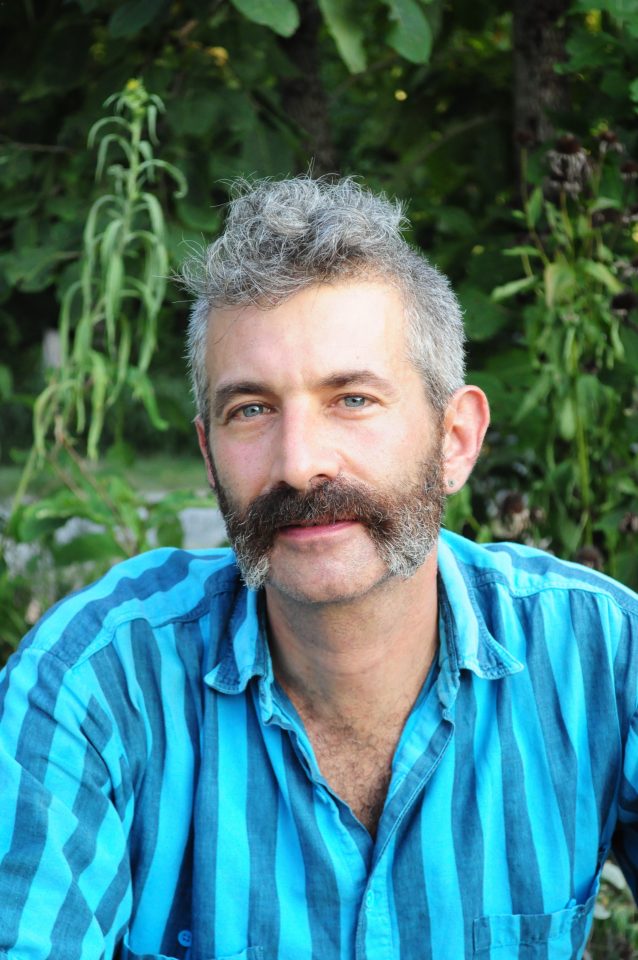
Sandor Katz
Sandor Katz, a self-proclaimed fermentation revivalist, became hooked on fermentation with his first homemade batch of sauerkraut, earning him the nickname “Sandorkraut”. As an AIDS survivor, he considers fermented foods an important part of his health and well-being. His 2003 book, Wild Fermentation, was lauded by Newsweek as the “fermentation bible”, and his 2012 book, The Art of Fermentation, received a James Beard award and was a finalist at the International Association of Culinary Professionals. In 2014, Katz received the Craig Claiborne Lifetime Achievement Award from the Southern Foodways Alliance.
See Sandor Katz May 11, 2016 at “Microbes: From Your Food to Your Brain”
- What hooked you on cooking?
- I’ve always loved eating, and my parents both cooked and we were always expected to help in the kitchen. I got especially interested in cooking from scratch, and understanding and experiencing how the raw products of agriculture are transformed into the foods we love to eat.
- The coolest example of science in your food?
- Our food is all biology and chemistry. Of course, I am most tuned into the biological processes, though at a certain level they break down to chemistry. One question that I have thought a lot about is: Why is fermentation practiced everywhere? I do not know this to be absolute fact, but I have been unable to find any counter-example. And the reason that we now understand is that all of the plants and animal products that make up our food are populated by elaborate microbial communities. Microbial transformation of our food is an inevitability and the question is how do we deal with that fact.
- The food you find most fascinating?
- I’m endlessly fascinated by kefir, a fermented milk, or rather by the culture that produces it, undulating rubbery masses known as kefir grains. These symbiotic communities of bacteria and yeast (SCOBIES) are incredibly complex, with more than 30 distinct organisms that have been identified.
- What scientific concept–food related or otherwise–do you find most fascinating?
- Co-evolution. How we have evolved with plants and microorganisms and how they have influenced what we are and how we have influenced what they are, and how each of these organisms has influenced the others. All the foods that’ve been interested in come about as a result of these co-evolutionary relationships.
- Your best example of a food that is better because of science?
- Certainly fermentation is better understood because of science, and it is possible thanks to science to replicate particular ferments in environments other than those in which they emerged as spontaneous outcomes. However, it is important to note that science has had negative effects on fermentation practices as well as positive ones. The presumption that large undefined communities of organisms are dangerous has led to the replacement of traditional starter cultures with pure culture starters that cannot easily be perpetuated, thus diminishing the ability of home, village, or small-scale producers to perpetuate cultures and thereby breeding dependence on starters purchased from a lab for each batch.
- How do you think science will impact your world of food in the next 5 years?
- I’m very excited by all the new findings in microbiology, especially our emerging understandings of microbial communities in different environments and their complex interactions. My hope is that our growing understandings of the functional importance of microbial communities will help us move beyond the war on bacteria, and embrace bacteria as our ancestors, allies, and greatest protection.
- One kitchen tool you could not live without?
- My crocks! Vessels are the most basic of kitchen tools.
- Five things most likely to be found in your fridge?
- Milk, yogurt, starter cultures, beer, miso. Kraut and kimchi might be in the fridge, or might be on the counter.
- Your all-time favorite ingredient? Favorite cookbook?
- Brussels sprouts, along with almost any cruciferous vegetable. They are so delicious and versatile! I like to check out cookbooks and explore recipes from diverse sources, but Joy of Cooking is my enduring go-to.
- Your standard breakfast?
- I love to use my sourdough starter to make savory vegetable sourdough pancakes, incorporating almost any vegetables, leftover grains if I have them, and cheese, topped off with fried eggs and yogurt-hot sauce.