Tropical Fruit Inspires Innovative Research
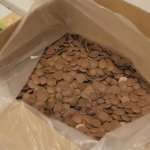
Two weeks from now, renowned Brazilian chef Alex Atala will be joining Science & Food for the first 2013 public lecture at UCLA. Chef Atala has generated a lot of buzz in the food world by discovering and classifying new ingredients from the Amazon basin. But Atala isn’t the only one looking to the South American rain forest for inspiration. By studying the fruit of the tropical plant Margaritaria nobilis (commonly known as the bastard hogberry), a team of researchers led by Dr. Mathias Kolle has created an amazing new material that changes color as it stretches.
Captivated by the shocking blue-green hue of the bastard hogberry, Kolle and his fellow researchers discovered that the hogberry has unique, elongated cells. Much like microscopic rolls of puff pastry, these hogberry cells are full of concentric layers that repeat at regular nano-scale intervals.
 |
| Cellular structure of the Margaritaria nobilis fruit. The bastard hogberry (a) is made up of long, cylindrical cells (b). A cross-section of a single cell reveals many concentric layers that repeat at nanometer intervals, as shown in (c). Scale bars are 200 µm (b) and 10 µm (c). |
It turns out that these cellular layers hold the key to the hogberry’s vibrant color. Visible light travels as a wave, with a wavelength in the 400 to 700 nanometer range; repetitive structures around this size (called “Bragg reflectors”) can interfere with visible light in such a way that only certain wavelengths, or colors, of the light are reflected. In the hogberry, the repeating layers within each cell reflect blue and green light to create the fruit’s blue-green appearance. Similar repeating patterns give certain beetles a jewel-like appearance and make squid eyes appear transparent underwater.
Armed with this new information, Kolle and his colleagues created synthetic fibers based on the hogberry’s cellular structure. Fibers were formed by layering two different elastic materials and rolling them around a glass rod thinner than the width of a human hair. By changing the thickness of the two layers, the researchers could control the final color of the fiber: thicker layers created fibers with redder hues, while thinner layers formed green or blue fibers.
 |
| Synthetic fibers based on the hogberry’s cellular structure. Two different elastic materials (blue and yellow) are rolled around a glass rod to create a single fiber (a). Changing the thickness of the layers changes the color of the fiber (b). Individual fibers are less than 100µm in diameter—only slightly thicker than a single hair. Scale bars are 20 µm (b). |
The researchers then went a step further by removing the glass rods to generate stretchy, elastic fibers. Stretching one of these fibers caused its individual layers to compress, thereby tuning the wavelength of reflected light and changing the fiber’s color.
 |
| Fibers change color as they are stretched. Before stretching, the fiber has thicker layers and appears red (far left). As the fiber is stretched (increasing strain) the layers become thinner and the color of the fiber moves through the visible light spectrum, ultimately appearing blue (far right). Scale bar is 50 µm. |
Now that these colorful fibers have been created, it’s exciting to imagine their potential applications. On their own, they could be used as flexible tension sensors; woven together, they could form high-tech optical fabrics and cutting-edge camouflage. Future research could even lead to new fibers that reflect UV or infrared light. Who would have thought so much innovation could come from studying such a small tropical fruit?
 About the author: Liz Roth-Johnson is a Ph.D. candidate in Molecular Biology at UCLA. If she’s not in the lab, you can usually find her experimenting in the kitchen.