Jeff Potter
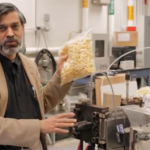
A science and food geek, Jeff Potter is the author of Cooking for Geeks: Real Science, Great Hacks, and Good Food, which the Washington Post called “one of the most useful books on understanding cooking.” He can be seen on TV engineering the world’s largest donut and is currently obsessed with the science of beverages. Check out more of Jeff’s food geekery at www.jeffpotter.org.

photo by John Zich, courtesy of www.zrimages.com | www.jeffpotter.org
- What hooked you on cooking? On science?
- I find it intensely gratifying to understand how things are made, and science really is about understanding how systems work and behave. Everyone eats, and almost everyone cooks, and the science behind both fascinates me. Plus, every time one steps foot into a kitchen, it’s inherently a science experiment, even if you don’t think about it that way. The amount of science that goes into the morning cup of coffee alone would shock most people. Plus knowing some science behind what you’re doing in the kitchen is one of the best instructors.
- Five things most likely to be found in your fridge?
- Eggs, yogurt, kale, hot sauce, beans.
- One kitchen tool you could not live without?
- A good sauté pan. Even a non-stick one. Really, you can get by without much at all, but one decent pan changes everything.
- Favorite cookbook?
- I was given a dessert cookbook years ago that was an anthology of sorts: one recipe from each of the top pastry chefs in the country. No pictures, not glossy, just a few lines on the chef and then the recipe. Every single recipe I made from that book came out amazing, and every single recipe managed to teach a new concept or idea. I don’t know if it’d stand up very well against all the food porn books that have now come out, but that book (given to me by a chef friend) was amazing for me.
- The scientific concept—food related or otherwise—you find most fascinating?
- That only a few basic building blocks—hydrogen, carbon, oxygen, nitrogen, and ok, fine, sulfur—are responsible for everything from bars of chocolate to a toucan flying around a rainforest in South America. The difference in complexity just one level up (molecules) from what seems so simple (atoms) is staggering; and then to consider that there are multiple layers up above that until we get to your brain understanding these words… mind-blowing.
- The coolest example of science in your food?
- You can tell where a tomato was grown—well, at least the latitude—by the ratio of various isotopes in it. It sounds crazy, but rainwater is not “pure” H2O; or more precisely, there are different isotopes of the “O” in “H2O” and the lighter one, 16O, is more likely to evaporate then the heavier one (takes less energy for it to take off). As you go toward the equator, evaporation rates in rainfall go up (it’s warmer, after all), so tomatoes grown toward the equator have higher concentrations of the heavier isotope 18O. The neat thing is that that ratio sticks with the food all the way down to the jar of fancy imported Italian pasta sauce, so you can semi-reliably tell where in Italy the tomatoes were grown if you look at enough of the various isotopes and minerals in it.
- Your all-time favorite food ingredient?
- I don’t really have a favorite food ingredient, but nothing beats fresh fruit at the peak of its season.
- The food you find most fascinating?
- Can I go with “beverages” as a general category? Everything from green tea to beer is amazingly complicated. Most food ingredients—apples to flour—are relatively unchanged from their “as-grown” state, but drinks are an entirely different category, as they’re entirely constructed.
- Are there any analogies you like to use to explain difficult or counter-intuitive food science concepts?
- Breaking of secondary and tertiary bonds in protein denaturation can be a bit confusing, as the “simple” model people have for molecules is that they’re made up of such-and-such atoms, without regard to the shape that the molecule takes impacts how it functions. I’ll sometimes describe the molecule as like an old-fashioned telephone cord (did I just date myself?), where the cord can twist up, kink, and tangle on itself.
- Your best example of a food that is better because of science?
- The egg. The amount of agricultural science and gains in productivity that have gone into chicken eggs in the past 100 years is just amazing. If the same “gains” had been made in humans, Olympic sprinters would be running at 65 miles per hour…
- Your standard breakfast?
- Depends on the time of year and where I am. Right now, in New England’s winter, yogurt with muesli, and then sautéed red onion, kale, garlic, two eggs, and a squeeze of lemon juice on top. If I feel like spending more than the two minutes it takes to make it, maybe some grated cheese on top.
- How does your scientific knowledge or training impact the way you cook? Do you conduct science experiments in the kitchen?
- I only cook on an amateur level, for myself and my friends; so for me cooking is a very ad-hoc thing, without too much fuss or worry about taking good, exact notes—but this is only because, generally speaking, I don’t need reproducibility of an entire dish! But I do perform little mini-experiments each time I cook. Take tonight (it’s after dinner as I write this)—I’ve been wondering why the tofu I’ve been cooking keeps sticking to the pan. It’s a stainless steel pan, and I put some oil in it—but it always seems to stick after it gets up above a certain temperature. I’m guessing it’s steam from the tofu pushing the oil away from the surface of the pan; and then the proteins in the tofu stick to the pan (and do not seem to release even when browned). I’ll probably kick myself later for writing this, as I’m guessing the “why” is simple here, but I was wondering if low heat versus high heat makes a difference… so I tried changing just that. Nope; still sticks. That’s the type of “mini” experimentation I love to encourage in the kitchen, because it doesn’t take any extra work to do it, beyond thinking about it.