Science and Food
  • Home
  • Public Events
    • Video Gallery
    • 2022 People, Food, & Climate
    • 2019 Food Waste
    • 2017 Future of Food
    • 2016 Public Lecture Series
    • 2014 Public Lecture Series
    • 2013 Public Lecture series
    • 2012 Public Lecture Series
  • Future Food Fellows
  • Building Community
  • Course
  • Press
  • Support Us
  • Contact Us
  • Click to open the search input field Click to open the search input field Search
  • Menu Menu

Bar Stools and Molecules: Buttery Nipple Science

January 27, 2015/in DIY Kitchen Science/by Grant Alkin

[Photo Credit: Vince C Reyes]

[Photo Credit: Vince C Reyes]

You may think a buttery nipple is just a fun shot to buy a friend on his or her birthday, but it’s more complex than that. It’s got layers… specifically two. For those not familiar with the bar classic, the buttery nipple is composed of a layer of Irish cream sitting on top of butterscotch schnapps.

Buttery Nipple Shot Recipe

½ oz. Irish cream
1 oz. Butterscotch schnapps

  1. Pour 1 oz. of Butterscotch schnapps into a chilled shot glass.
  2. Carefully pour ½ oz. of Irish cream onto the back of a downturned spoon so it rolls from the spoon and floats on the surface of the schnapps.
  3. Enjoy!

This and other layered shots like the American flag, the B-52, and the Alien Brain Hemorrhage, take advantage of the slight differences in density among spirits. As density, a substance’s mass per unit volume (Density = mass / volume), dictates the layering in these drinks; the most dense liquid is placed at the bottom followed by progressively less dense liquids. In the case of the buttery nipple, the less dense Irish cream floats on the more dense butterscotch schnapps. If you were to reverse the order with the butterscotch schnapps poured on the Irish cream, the layers would not form. The more dense butterscotch schnapps would sink to the bottom of the glass and result in a mixture of the two spirits.

For the home bartender looking to make new layered drinks, the absolute density of a spirit is not always easy to measure. However, a different quantity, specific gravity, is often available online1. Specific gravity is the ratio of the density of substance to water (specific gravity = density of a substance / density of water). Water has a specific gravity of 1.0. More dense liquids have specific gravities greater than 1.0 and less dense liquids have specific gravities less than 1.0. In the case of the buttery nipple shot, butterscotch schnapps (Dekyper’s ButterShots) has a specific gravity of 1.12 while Irish cream (Bailey’s) has a specific gravity of 1.06.1 The specific gravity is often available online for alcoholic beverages because it is important in the fermentation and distillation process, and different beers, wines, and spirits have characteristic specific gravities.

If the specific gravity of an alcoholic beverage cannot be found, some recommend using proof or alcohol by volume (ABV) to layer drinks. Both are mandated on all alcoholic beverages sold and therefore easy to find. In general, proof is the amount of alcohol in a beverage. Specifically in the US, proof is defined as twice the percentage of the alcohol by volume. The alcohol in any beverage you drink is ethyl alcohol, also called ethanol (C2H6O).

Figure 1: Molecular Formula of Ethanol [Image Credit: Vince C Reyes]

Figure 1: Molecular Formula of Ethanol [Image Credit: Vince C Reyes]

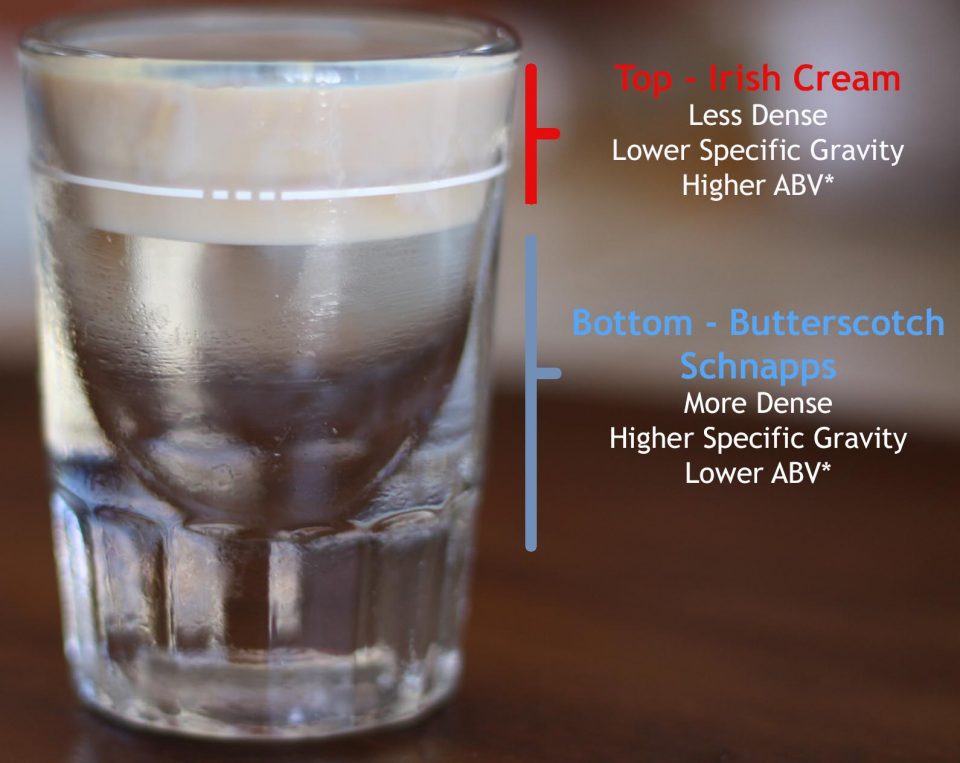
At room temperature (77°F or 25°C), ethanol has an absolute density of 789.00 kg/m3 and a specific gravity of 0.7872. As many alcoholic spirits are primarily a mixture of ethanol and water, which has an absolute density of 999.97 kg/m3 and specific gravity 1.0, greater alcohol content can often correspond to a smaller density. For example in the case of the buttery nipple, Irish cream (Baily’s) is 17% ABV, while Butterscotch schnapps is 14.8% ABV. Therefore, the higher alcohol content and corresponding lower density of the Baily’s Irish cream allows it to sit on top of butterscotch schnapps. This shortcut, however, is not always correct as many spirits have ingredients other than water and ethanol. Many spirits contain cream, sugars, or other flavoring agents, which can change their densities, making alcohol content an imperfect proxy for density. For example, Smirnoff’s flavored vodkas all have 35% ABV, but have varying specific gravities: citrus vodka has a specific gravity of 0.96, while the more dense watermelon vodka has a specific gravity of 0.981.

Figure 2: Layering in a Buttery Nipple.  *ABV is not always an indicator of density. [Image Credit: Vince C Reyes]

Figure 2: Layering in a Buttery Nipple.
*ABV is not always an indicator of density. [Image Credit: Vince C Reyes]

Lastly although other factors such as altitude affect density, temperature is the other most relevant factor for an aspiring bartender. Liquids are denser when cold. Temperature is an indicator of the speed of molecules within a substance. At low temperatures, liquids have slower moving molecules that pack closer together resulting in greater mass per volume. In contrast, at higher temperatures, molecules in liquids move around more quickly and take up less space resulting in a reduced density. For example, water near room temperature (70°F [21°C]) is less dense (0.998 g/cm3), than water near freezing (1.000 g/cm3 at 39.2 °F [4.0 °C])3. This is why using chilled spirits, glass wear, and spoons when making a layered shot can ensure that spirits remain at their densest and form layers.

Ultimately, a great layered shot is one that is not only effectively layered, but also delicious. If you don’t enjoy the buttery nipple, you now have the scientific knowledge to experiment with your own concoctions!

Learn more

  1. Specific Gravity of Different Spirits from GoodCocktails.com
  2. Specific Gravity of Other Liquids from Engineering Tool Box
  3. The Density of Water at Different Temperatures from the US Geological Survey

Vince ReyesAbout the author: Vince C Reyes earned his Ph.D. in Civil Engineering at UCLA. Vince loves to explore the deliciousness of all things edible.

Read more by Vince Reyes


Tags: alcohol, Bar Stools and Molecules, Buttery Nipple, cooking, food, science, shots
Share this entry
  • Share on Facebook
  • Share on X
  • Share on Pinterest
  • Share on LinkedIn
  • Share on Tumblr
  • Share on Vk
  • Share on Reddit
  • Share by Mail
https://www.scienceandfood.org/wp-content/uploads/sites/123/2015/01/diagram.jpg 1264 1590 Grant Alkin https://sites.lifesci.ucla.edu/ibp-scienceandfoodnew/wp-content/uploads/sites/123/2016/09/newlogoSm-2-300x31.png Grant Alkin2015-01-27 10:00:002015-01-27 10:00:00Bar Stools and Molecules: Buttery Nipple Science
You might also like
The Molecules of Food and Nutrition
Fancy Chocolate Treats
Morihiro Onodera
Rachel Dutton
Structural Changes in Chocolate Blooming
Microwave Cuisine & Sustainable Meat
Inside the Experimental Cuisine Collective
10 Things About Sushi
Search Search

Recent Posts

  • Hello world!
  • Hello world!
  • Hello world!
  • Aquafaba Meringues
  • Vertical Farming & Micro-Gardening

Archives

  • March 2017
  • November 2016
  • August 2016
  • May 2016
  • April 2016
  • March 2016
  • February 2016
  • January 2016
  • December 2015
  • November 2015
  • October 2015
  • September 2015
  • August 2015
  • July 2015
  • June 2015
  • May 2015
  • April 2015
  • March 2015
  • February 2015
  • January 2015
  • December 2014
  • November 2014
  • October 2014
  • September 2014
  • August 2014
  • July 2014
  • June 2014
  • May 2014
  • April 2014
  • March 2014
  • February 2014
  • January 2014
  • December 2013
  • November 2013
  • October 2013
  • September 2013
  • August 2013
  • July 2013
  • June 2013
  • May 2013
  • April 2013
  • March 2013
  • February 2013
  • January 2013
  • June 2012
  • May 2012
  • April 2012

Categories

  • Contests
  • Course Lectures
  • DIY Kitchen Science
  • Flavor of the Month
  • News & Views
  • Profiles
  • Public Lectures
  • Science & Food
  • Uncategorized
  • What We're Reading

Meta

  • Log in
  • Entries feed
  • Comments feed
  • WordPress.org
Link to: Roger Pigozzi Link to: Roger Pigozzi Roger Pigozzi Link to: Flavor in Evolution and Inebriation Link to: Flavor in Evolution and Inebriation Flavor in Evolution and Inebriation
Scroll to top Scroll to top Scroll to top