Kent Kirshenbaum
Dr. Kent Kirshenbaum received his PhD in Pharmaceutical Chemistry at UCSF, is an NSF Career Award recipient, and is currently a professor of Chemistry at NYU. His research focuses on the creation of new peptide-based macromolecules that can be used as research tools or therapeutic strategies. In 2012, he filed a patent for a foaming agent which acts as a vegan substitute for egg whites, making vegan meringues a delicious possibility.

- What hooked you on cooking?
- Spending time with my mom got me hooked on cooking. She exemplified the “slow food” concept, and she’d take days to make a pasta sauce. I grew up in a drafty house in San Francisco that was cold all year around, and being near her at the stove was the warmest place to be. Once my wife and I had kids, I realized how satisfying it was for me to provide my family with sustenance through cooking and culture through cuisine.
My dad got me hooked on science. He studied metallurgy and worked for a mining company. He would go on business trips and bring me back samples of different minerals to play with. It was kind of like the situation described in the book “Uncle Tungsten” by Oliver Sachs.
- The coolest example of science in your food?
- Mayonnaise. You take two immiscible liquids – oil and water, and find a way to get them to mix. How do they do that?? Add an emulsifier, provide some energy and voila! It’s just a shame the product itself is so repugnant.
- The food you find most fascinating?
- Fermented butters. Such as smen, the fermented butter of North Africa and “bog butter” from the British Isles.
- What scientific concept–food related or otherwise–do you find most fascinating?
- I’m fascinated by the relationship between the sequence, structure and function of proteins.
In the kitchen, transglutaminase — also known as meat glue — is a compelling example of enzymology. Nixtamilization is an amazing concept, and the word “nixtamilization” itself is like a really short poem.
- Your best example of a food that is better because of science?
- Either Pop Rocks or the clean water that comes out of my home faucet. Although I’m not sure either of them really qualify as a foodstuff.
- We love comparing the gluten in bread to a network of springs. Are there any analogies you like to use to explain difficult or counter-intuitive food science concepts?
- When explaining specificity in the sensory perception of food, I use the “lock in key” analogy to describe how ligands engage protein receptors. Although the analogy is imperfect, it begins to get the idea across.
- How does your scientific knowledge or training impact the way you cook? Do you conduct science experiments in the kitchen?
- Because I am trained as a chemist, I am fastidious about following a published protocol (recipe) and I tend to be absurdly precise about volumes. I love experimenting with food – we filed a patent application on new way to make vegan meringues. But when it comes to cooking at home I tend to be a traditionalist.
- One kitchen tool you could not live without?
- My home water carbonation system. I love sparkling water that I can generate from the New York City public water supply and doesn’t need to be shipped from a European spring.
- Five things most likely to be found in your fridge?
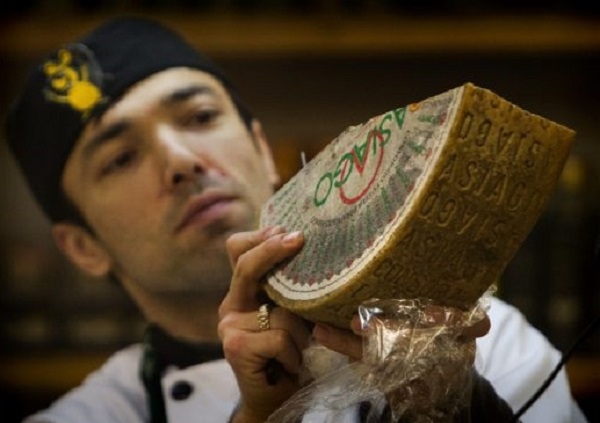
- Harissa, capers, preserved sour cherries, home-made stock and parmesan cheese. I get anxious if my supply of Reggiano is running low.
- Your all-time favorite ingredient? Favorite cookbook?
- I’m a spice guy. Right now I’m fixated on sumac and cardamom. My favorite cookbooks is “Where Flavor Was Born” by Andreas Viestad which explores how spices are used across the region of the Indian Ocean. It inspired me to visit a cardamom plantation in Kerala, India.
Other favorites include “In Nonna’s Kitchen” and “Cucina Ebraica”, because these books connect me to the memories of my mother and her mother.
- Your standard breakfast?
- A cup of black coffee and a baked good that I enjoy on my walk from home to my lab. New Yorkers have a bad habit of walking and eating. On the weekends, bagels and smoked salmon. No doughnuts. Never a doughnut. Maybe a beignet. But only in New Orleans.