Fruit Images & Wasabi Meds

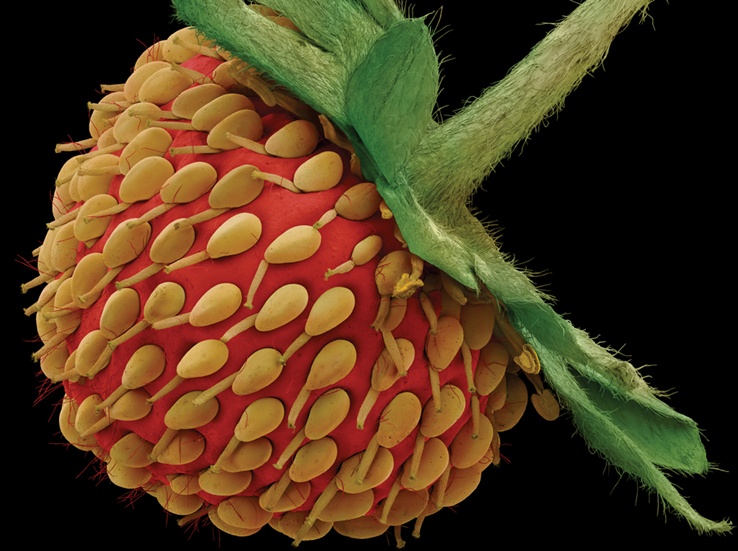
Yes, that’s a strawberry as seen from under the microscope. Wait ’til you see what a peach looks like zoomed in. For more “Whoa!”, the burn from wasabi could be useful in developing new pain medications.
Read more

Yes, that’s a strawberry as seen from under the microscope. Wait ’til you see what a peach looks like zoomed in. For more “Whoa!”, the burn from wasabi could be useful in developing new pain medications.
Read more

At our 2014 Science of Sushi event, Dr. Ole Mouritsen and Chef Morihiro Onodera illuminated the science underlying some of our favorite components of sushi. In case you still haven’t had your fill, here are 10 scientific facts related to sushi: Read more

Photo credit: Jun OHWADA (しそ山葵) (june29/Flickr)
Wasabi packs quite a punch, but where exactly does that wallop of heat come from? That green dollop that accompanies sushi comes from the wasabi plant, also known as Japanese horseradish, which is not to be confused with its distant cousin, the more common and well-known European horseradish (Armoracia rusticana). As a member of the Cruciferae family, wasabi is actually more closely related to cabbage, cauliflower, broccoli, and mustard [1][2].
Grown primarily in Japan, the wild-type species (Wasabia tenuis) are only found mountainside in streambeds and river sand bars [2]. Cultivated wasabi plants (W. japonica), similar to the wild-type variety, comprise a cluster of long-stemmed heart-shaped leaves and delicate, spring-blooming, white flowers branching from a gnarled, thick, root-like stem known as a rhizome [3]. Wasabi grown under semi-aquatic conditions are called sawa, while those grown in fields are called oka [1][3]. Sawa is considered higher quality, as they produce larger rhizomes, thereby often cultivated for culinary purposes. Oka is largely cultivated for nutraceutical purposes, such as herbal supplements [3].

Wasabi leaves and rhizomes. Photo credit: Jaden (Steamy Kitchen)
The plants are notoriously difficult to cultivate, as they thrive best in running water [4]. Even under ideal conditions, wasabi is difficult to farm, especially on large-scale operations for commercial purposes. As such, real wasabi is expensive and rare outside of Japan. Due to the taste similarities between wasabi and horseradish, common wasabi substitutes are usually a mixture of horseradish, mustard, starch, and green food coloring. So how does one differentiate between real and imitation wasabi? Simply taste it.
Real wasabi is made by grating the wasabi rhizome into a fine powder. Due to the high volatility of the flavor compounds, after grating the rhizome, the heat will only last for, at most, fifteen minutes, whereas horseradish-based wasabi can be left overnight and still retain its heat [1]. Additionally, though the chemical makeup of horseradish and wasabi may be similar, it is different enough that each has a unique flavor profile. Both horseradish and wasabi rhizomes contain thioglucosides, a sugar glucose with sulfur-containing organic compounds. Maceration of the rhizome, such as by grating, breaks the cell walls and releases these thioglucosides, as well as an enzyme known as myrosinase [1]. Myrosinase is responsible for breaking the thioglucosides into glucose and a complex mixture of a class of compounds called isothiocyanates. Horseradish and wasabi contain varying isothiocyanate amounts and compositions. There are 1.9g total isothiocyanates per kilogram of horseradish, as opposed to 2.1g/kg in wasabi. The most abundant and stable of these compounds, allyl isothiocyanate, gives real and imitation wasabi its infamous pungency [1][4]. The next most abundant isothiocyanate compound is 2-phenylethyl isothiocyanate, which is only found in horseradish [1]. All other types of isothiocyanates exist in higher concentrations in wasabi than horseradish.

Allyl isothiocyanate produces a hotness in wasabi that is distinct from the spiciness of hot peppers. Hot peppers contain capsaicin, an oil-based molecule which stimulates the tongue. This spiciness can only be washed away with foods containing oils or fats, such as dairy products. Unlike capsaicin, allyl isothiocyanate vapors stimulate the nasal passages. Fortunately for heat-seekers, the amount of pain is directly related to the amount of wasabi consumed, and a little will go a long way. Fortunately for mild-lovers, because allyl isothiocyanate is not oil-based, the burning can easily be cleansed by consuming more of any food or liquid. Although real wasabi is expensive and only found at specialty stores or prepared to order at high-end restaurants, that sinus-opening sharpness is worth experiencing, even if only once.
References Cited
 About the author: Alice Phung once had her sights set on an English degree, but eventually switched over to chemistry and hasn’t looked back since.