Science and Food
  • Home
  • Public Events
    • Video Gallery
    • 2022 People, Food, & Climate
    • 2019 Food Waste
    • 2017 Future of Food
    • 2016 Public Lecture Series
    • 2014 Public Lecture Series
    • 2013 Public Lecture series
    • 2012 Public Lecture Series
  • Future Food Fellows
  • Building Community
  • Course
  • Press
  • Support Us
  • Contact Us
  • Click to open the search input field Click to open the search input field Search
  • Menu Menu

Plants under pressure

May 16, 2012/in Science & Food/by Grant Alkin

In our unit on pressure, we used plants as a model system. What makes lettuce crispy? How do you revive wilted lettuce? It’s really all about pressure- turgor pressure, to be exact.

TurgorPressure

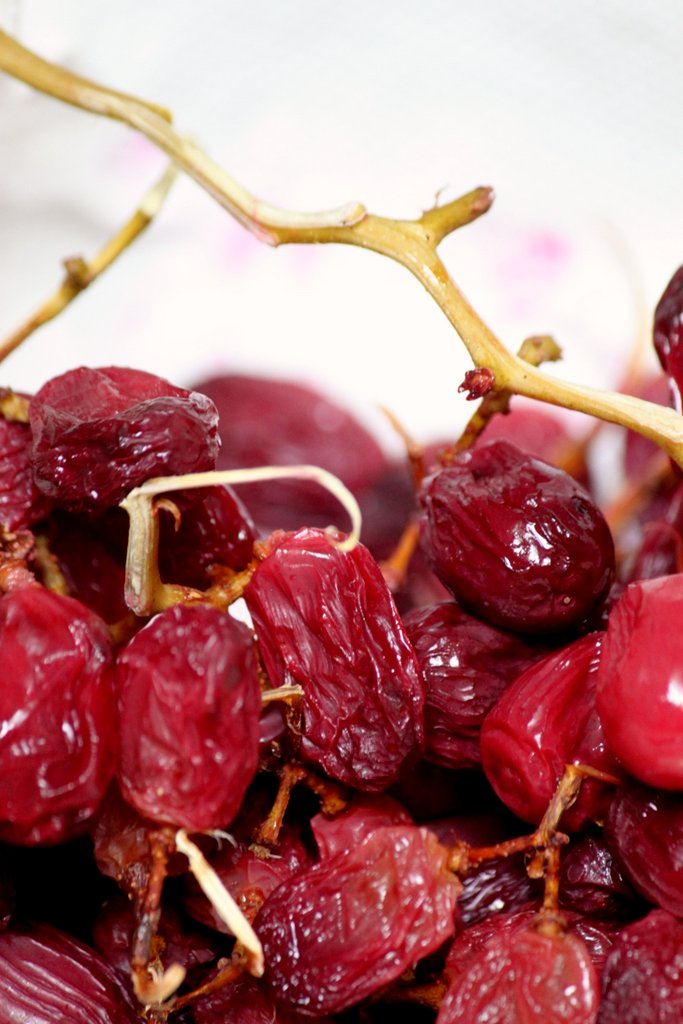
We prepared tasting samples of dehydrated grapes (aka raisins) and kale chips to demonstrate the vital role that water and pressure play in plants. Under normal conditions, grapes are juicy and firm, and kale is hardy and stiff. We placed both in a dehydrator, which works as a low-temperature oven (~130 °F/54 °C). Water evaporates, and the cells lose turgor pressure and shrink. The grape becomes soft and mushy on the inside, and the kale, which is normally so tough and sturdy, shatters like a chip.

And for reviving that wilted lettuce? Soak it in cold water, of course.


RECIPES

Dehydrated Grapes

Grapes
Boiling water
Dehydrator

1) Wash grapes well.
2) Bring a pot of water to a boil. Blanch* grapes in boiling water for 30-60 s.
3) Pat grapes dry.
4) Places grapes on dehydrator racks. Turn on dehydrator. If it has a temperature setting, some recipes suggest 140 °F. Our dehydrator has only one temperature setting of ~130 °F, so we just went by touch. A wrinkled grape with a still-moist center takes 3-4 hours.

*Blanching dissolves the waxy cuticle on the surface of grapes. The wax is a natural defense mechanism against water evaporation.

Kale Chips

Kale
Olive oil
Salt
Pepper
Paprika, cumin, other seasonings

1) Rinse and dry kale leaves. Cut lengthwise in half, and again in thirds.
2) Toss kale with olive oil in bowl. Sprinkle with salt, pepper, and other seasons.
3) Arrange leaves in single layer on dehydrator racks. Turn dehydrator on. Let run for ~2 hours.

https://www.scienceandfood.org/wp-content/uploads/sites/123/2012/05/img_2991.jpg 1024 683 Grant Alkin https://sites.lifesci.ucla.edu/ibp-scienceandfoodnew/wp-content/uploads/sites/123/2016/09/newlogoSm-2-300x31.png Grant Alkin2012-05-16 14:20:012012-05-16 14:20:01Plants under pressure

René Redzepi and Lars Williams on Deliciousness

May 8, 2012/in Public Lectures/by Grant Alkin

René Redzepi and Lars Williams of Noma and Nordic Food Lab finally made it to UCLA!

We had quite an adventure leading up to their lecture, which involved mole crabs, sand fleas, live crickets, lost luggage, liquid-nitrogen-seaweed ice cream, and much more.

René Redzepi spoke about the pursuit of ‘deliciousness’:

“It’s not about creating dishes, but understanding deliciousness…to provide knowledge and scientific concepts for chefs.”

René’s ideology was born when he had a eureka-moment while grating and preparing horseradish.

“Some days the horseradish was sweet, some days it was acidic, some days, spicy to the point where I had to walk away. Sometimes the shape was short, sometimes long. How is it that we’d be able to create a consistent menu, with such variable changes week by week, season by season?”

He voiced what he thought was the answer.

“A chef’s intuition, combined with scientific know-how.”

Hence, the birth of the Nordic Food Lab. This is Redzepi and his team’s solution to creating a medium between food and science. Here, his talented team delves into the concept of deliciousness: how can they create and optimize using the ingredients that natures provides? (Remarkably, a good deal of their experimentation happens inside a houseboat shored in the picturesque Copenhagen harbor).

Head of Research & Development at Nordic Food Lab, Lars Williams, introduced a sampling of their recent experiments including how to modify and generate unique flavors using local and natural ingredients. One of the team’s favorite recent topics is fermentation, and a delicious example they shared was barley koji. The procedure is as follows.

  1. Crickets are blended up and mixed with barley
  2. The mixture is left to incubate, during which time, enzymes (such as amylases and proteases) in the barley and cricket guts, as well as microbes, take action.
  3. The resulting moldy mass is transformed into a nutty sweet delectable treat. (They did state they wanted to increase the amount of critters on the menu).

Nordic Food Lab also experiments with native Danish ingredients, such as seaweeds: a delicious example was their seaweed ice cream, which was created by extracting flavors of dulse into ice cream. To determine the optimal conditions for flavor extraction, they did a series of experiments to quantify levels of glutamate, aspartate and alaninate. You may be familiar with glutamic acid as a flavor enhancer, monosodium glutamate or MSG, more commonly known as small, powdery white crystals at the Asian market, or heavily-dosed out in Chinese food.

These are just a couple of examples of cutting-edge work emerging from the Nordic Food Lab; the possibilities are endless, and it will be exciting to follow their progress as they explore and share these exciting new innovations. Check out their recent publication to learn more about Seaweeds for Umami Flavor in New Nordic Cuisine.

For those you who didn’t get to taste the cricket sauce (or just can’t get enough), hit up LA Weekly’s Squid Ink for an additional recap of last night’s lecture.

https://www.scienceandfood.org/wp-content/uploads/sites/123/2012/05/img_3065-001.jpg 1024 1024 Grant Alkin https://sites.lifesci.ucla.edu/ibp-scienceandfoodnew/wp-content/uploads/sites/123/2016/09/newlogoSm-2-300x31.png Grant Alkin2012-05-08 12:33:152012-05-08 12:33:15René Redzepi and Lars Williams on Deliciousness

Gary Menes’ Veggie Platter

May 7, 2012/in Course Lectures/by Grant Alkin

This week’s lecturer is Gary Menes. He is the chef at Le Comptoir, a pop-up restaurant at Tiara Café in LA. 

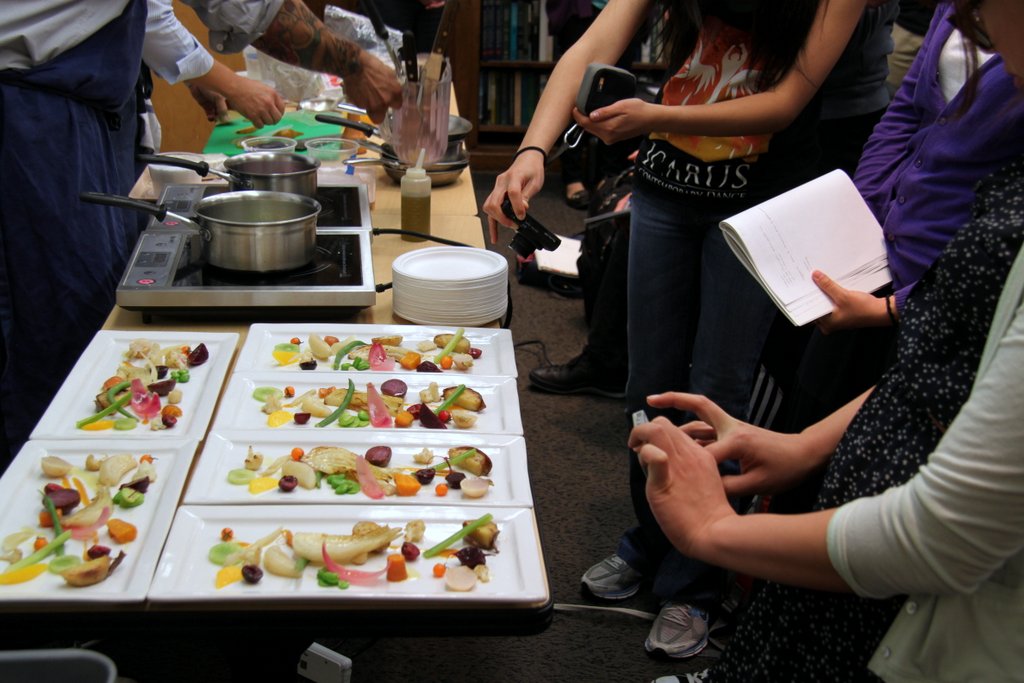
Gary Menes and sous-chef Wesley Avila weighed in on our topic of the week, “Pressure,” with their version of the veggie platter.  There were 20-odd vegetables and fruits present, including pickled onions, the season’s first cherries, pickled orange segments, Okinawan sweet potato, and quickly sautéed fava beans.

Gary packed cherries in a bag and used a cryovac machine to suck out all the air in the bag. The resultant vacuum compresses and bruises the cherries, changing their texture and flavor in the process.

Want to make quick-pickled onion petals? Slice the onion in quarters or halves and peel apart the layers to get petals. Heat up a quick-pickling solution of 3 parts water : 2 parts red wine vinegar : 1 part sugar. Once hot, submerge the petals and let rest for 30 minutes.


https://www.scienceandfood.org/wp-content/uploads/sites/123/2012/05/img_30581.jpg 683 1024 Grant Alkin https://sites.lifesci.ucla.edu/ibp-scienceandfoodnew/wp-content/uploads/sites/123/2016/09/newlogoSm-2-300x31.png Grant Alkin2012-05-07 00:43:372012-05-07 00:43:37Gary Menes’ Veggie Platter

“It’s all about sugar” – Barbara Spencer

May 1, 2012/in Course Lectures/by Grant Alkin

Barbara Spencer of Windrose Farm in Paso Robles was our lecturer on the topic of phase transitions. 

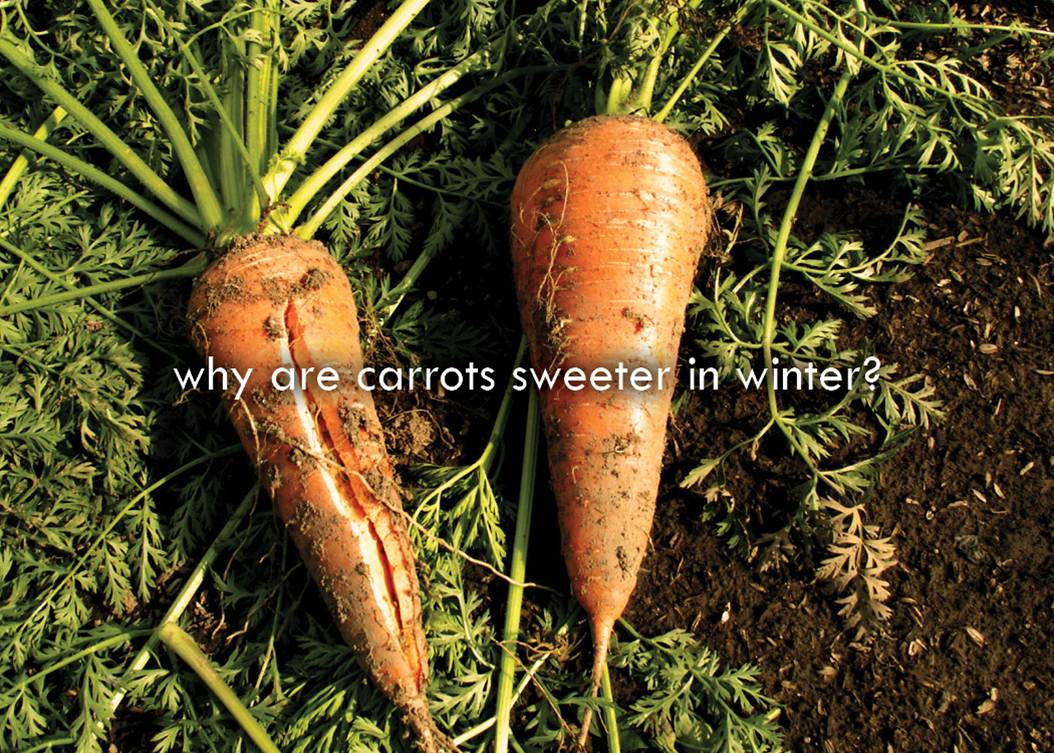
“Why are carrots harvested after winter particularly sweet?”

Plants use sugar as an internal antifreeze. This is an example of the concept of freezing point depression. When a solution freezes, the molecules into a crystalline structure. However, when impurities are introduced to the solution, they block the molecules from clustering together and freezing. In the case of carrots, sugar is the impurity, and it keeps the liquid inside the plants from freezing at 0 °C. This defense mechanism against frost translates into carrots that taste extra sweet to us. Even on a daily basis, Barbara always picks her carrots and melons before the sun comes up, because sugar levels increase at night. Strawberries ripen at night, too.

Image courtesy of farmstayus.com

Out where the farm is in Paso Robles, the valley makes for a very active microclimate. The difference between daily temperature highs and lows can be as large as 50 °F. Apples, which need a certain number of hours of frost, thrive well there.

Storage is just as important as growth, and Barbara invested in a refrigerated truck for transporting vegetables. Leafy greens always need water, and this is why supermarkets and farmers are always spraying or misting. There is a rule of thumb that every hour lost in not cooling freshly picked vegetables to the proper temperature equals one less day of shelf life.

We were surprised to learn about the storage capabilities of some apple varieties, such that you can keep them for months on end. They’ll be good right after picking, become very gnarly quickly, and then, if you wait long enough, they’ll taste fantastic again. Which varieties do you know are like that?

https://www.scienceandfood.org/wp-content/uploads/sites/123/2012/05/carrots.jpg 753 1054 Grant Alkin https://sites.lifesci.ucla.edu/ibp-scienceandfoodnew/wp-content/uploads/sites/123/2016/09/newlogoSm-2-300x31.png Grant Alkin2012-05-01 13:28:012012-05-01 13:28:01“It’s all about sugar” – Barbara Spencer

Jordan Kahn on the Molecules of Food

April 26, 2012/in Course Lectures/by Grant Alkin

Jordan Kahn came in as our terrific pinch hitter when René Redzepi fell ill the night he was to fly over from Copenhagen for his lecture with Lars Williams. He was the first lecture of the class and provided an introduction to looking at food as molecules. Jordan is the chef/partner at Red Medicine in LA.

Jordan brought in an incredible bounty of wild plants, herbs, and flowers foraged just the day before in nearby Topanga Canyon.

He explained, and we tasted:

  • wood sorrel
  • chrysanthemums
  • radish pods
  • California bay leaf
  • young fennel
  • mustard
  • and more

Many wild plants have a much more intense and often completely different flavor than do their domestic counterpart. Why is this so? 1) Remember that from the botanical perspective, these ‘smelly’ molecules are defense mechanisms for the plant and help to repel predators. Wild plants face a greater selective pressure and therefore, perhaps evolution has selected for the most potent smelling plants. 2) Perhaps domestic herbs bought at the supermarket experience a dramatic degradation of flavor after harvesting. 3) Terroir affects taste, so that fennel foraged from Topanga Canyon tastes differently than does fennel from San Diego. Jordan gathered everything that he brought within a 30 sq. ft area. Herb farms, on the other hand, may be quite homogeneous in terrain as well as crop.

https://www.scienceandfood.org/wp-content/uploads/sites/123/2012/04/img_2739-001.jpg 683 1024 Grant Alkin https://sites.lifesci.ucla.edu/ibp-scienceandfoodnew/wp-content/uploads/sites/123/2016/09/newlogoSm-2-300x31.png Grant Alkin2012-04-26 13:12:512012-04-26 13:12:51Jordan Kahn on the Molecules of Food

Nathan Myhrvold and The Science of Barbeque

April 26, 2012/in Public Lectures/by Grant Alkin

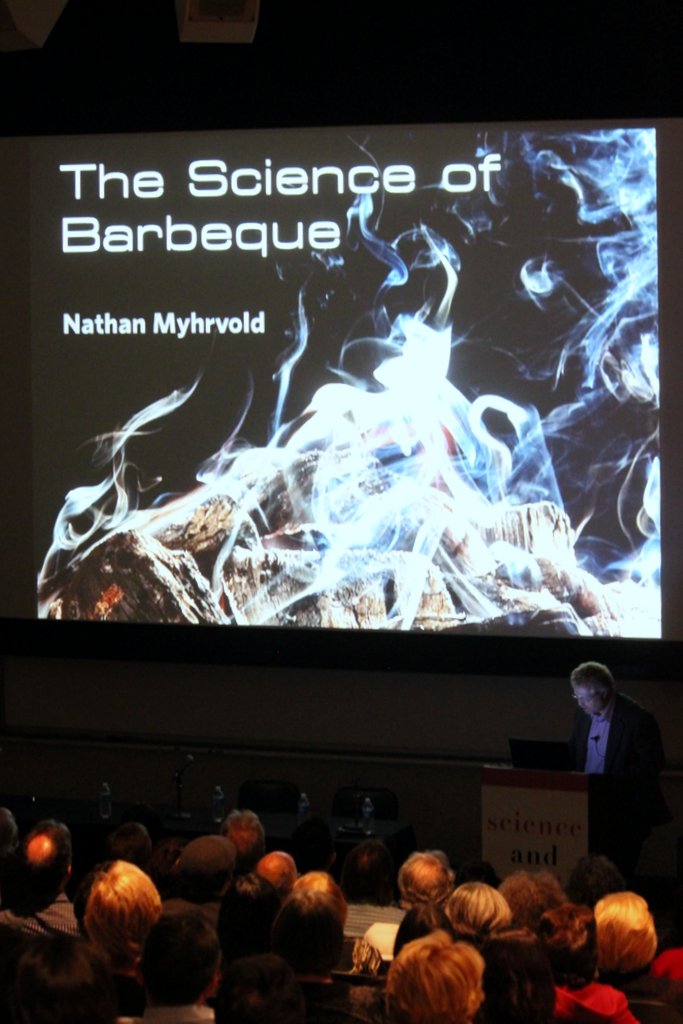
Last night, Nathan Myhrvold, of Modernist Cuisine, kicked off our inaugural Science and Food Public Lecture Series with a succinct and entertaining lecture on the science of BBQ.

After the lecture, the eloquent Evan Kleiman moderated a panel discussion and Q&A session with Nathan, Amy Rowat, Jon Shook, and Vinny Dotolo.

https://www.scienceandfood.org/wp-content/uploads/sites/123/2012/04/img_2912.jpg 1024 683 Grant Alkin https://sites.lifesci.ucla.edu/ibp-scienceandfoodnew/wp-content/uploads/sites/123/2016/09/newlogoSm-2-300x31.png Grant Alkin2012-04-26 11:56:202012-04-26 11:56:20Nathan Myhrvold and The Science of Barbeque
Page 13 of 13«‹111213
Search Search

Recent Posts

  • Hello world!
  • Hello world!
  • Hello world!
  • Aquafaba Meringues
  • Vertical Farming & Micro-Gardening

Archives

  • March 2017
  • November 2016
  • August 2016
  • May 2016
  • April 2016
  • March 2016
  • February 2016
  • January 2016
  • December 2015
  • November 2015
  • October 2015
  • September 2015
  • August 2015
  • July 2015
  • June 2015
  • May 2015
  • April 2015
  • March 2015
  • February 2015
  • January 2015
  • December 2014
  • November 2014
  • October 2014
  • September 2014
  • August 2014
  • July 2014
  • June 2014
  • May 2014
  • April 2014
  • March 2014
  • February 2014
  • January 2014
  • December 2013
  • November 2013
  • October 2013
  • September 2013
  • August 2013
  • July 2013
  • June 2013
  • May 2013
  • April 2013
  • March 2013
  • February 2013
  • January 2013
  • June 2012
  • May 2012
  • April 2012

Categories

  • Contests
  • Course Lectures
  • DIY Kitchen Science
  • Flavor of the Month
  • News & Views
  • Profiles
  • Public Lectures
  • Science & Food
  • Uncategorized
  • What We're Reading

Meta

  • Log in
  • Entries feed
  • Comments feed
  • WordPress.org
Scroll to top Scroll to top Scroll to top