
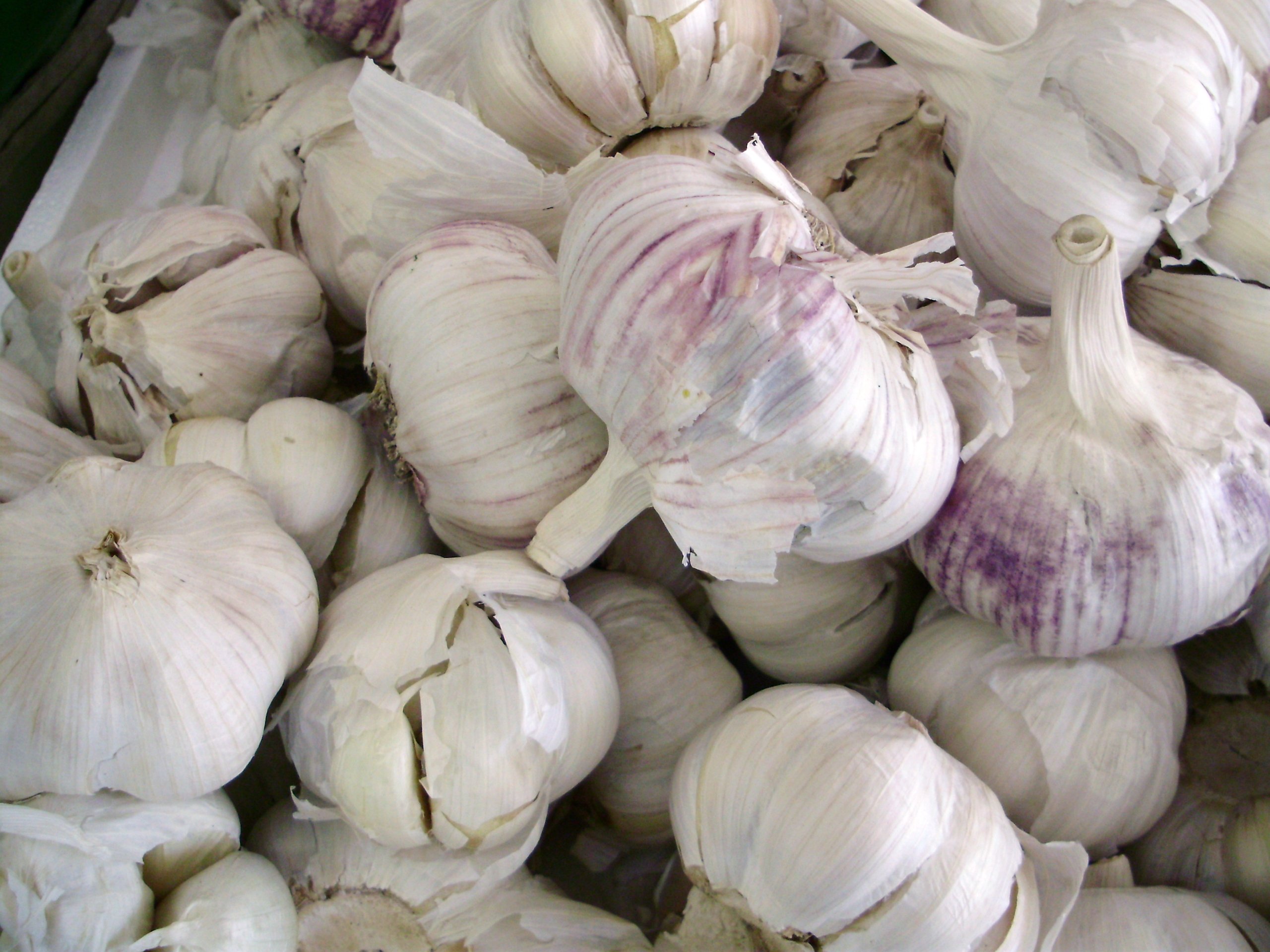
Garlic

Image Credit: Robert Benner (mullica/Flickr)
If you’ve ever made the mistake of devouring three bowls of James Beard’s Garlic Soup a few hours before The Job Interview Of Your Life (I’m not speaking from experience here), you will recognize the frantic moment in which you pray that 1) the handful of mints burning in your mouth have superpower strength, or 2) your interviewers cannot smell, or 3) whoever you’re meeting had four bowls of garlic soup. Ahhh, the allure and woe of garlic. Why do you hate me if I love you so much?
Known for its distinct aroma and taste, Allium sativum – or garlic, as most of us know it – makes dishes sweet and pungent while it turns breaths foul and fetid. But what exactly causes garlic breath? More importantly, how do you get rid of it?

“Dear god, what did this guy have for lunch?” — Image Credit: (fiverlocker/Flickr)
The Breakdown of Garlic Breath
Garlic contains many sulfur compounds, but the ones most responsible for garlic breath are: diallyl disulfide, allyl methyl disulfide, allyl mercaptan, methyl mercaptan, and allyl methyl sulfide (AMS). The gases released by all of these compounds, except forAMS, originate in the oral cavity when we mechanically crush garlic in our mouths, so brushing your teeth and tongue will reduce the presence of the mouth-originated odors. However, good dental hygiene doesn’t usually entirely get rid of the smell because AMS is what causes unwelcome garlic breath, and this can linger for several hours or even days.

Allyl Methyl Sulfide (AMS), the unwanted pungent houseguest that overstays its welcome. — Background Credit: Crispin Semmens (conskeptical/Flickr)
AMS is a sulfur compound formed inside the body from allyl mercaptan, so instead of originating in the mouth, AMS is produced in the microflora of the gut. The resultant gas quickly evaporates into the bloodstream, which then diffuses to the lungs and infuses each breath of air that leaves our bodies with traces of strong-smelling allyl methyl sulfide. And if that isn’t wonderful enough, the compound is also released through pores of the skin, which is why you may notice a lingering body odor after garlic-heavy meals. Unfortunately, AMS does not get metabolized in your gut and liver like many other molecules that we eat, so it takes much longer for AMS to breakdown – which is why the AMS stays in the body for many hours later. [1]
SOLUTIONS: When brushing your teeth (sadly) isn’t enough

Image Credit: Robert Bertholf (robbertholf/Flickr)
-
EAT THIS: Parsley, Spinach, Mint, Apples, Pears, plus any fruits and veggies that are prone to browning (think avocados, bananas, potatoes, etc.)
WHY: These foods contain an enzyme called polyphenol oxidase. (The same enzyme is what makes your fruit salad look brown!). When this compound is exposed to oxygen, it reacts in a way that reduces both the odors of the volatile compounds and the formation of more AMS. [2]

Image Credit: A Girl With Tea (agirlwithtea/Flickr)
-
DRINK THIS: Green Tea, Coffee, Ku-Ding-Cha (a bitter-tasting Chinese tea), Prune Juice
WHY: These drinks contain a polyphenolic compound called chlorogenic acid, which is another chemical that works to deodorize garlic-derived sulfur compounds on human breath. [2]

Image Credit: (Unsplash/Pixabay)
-
ALSO DRINK THIS: Lemon juice, Soft Drinks, Beer, Hot Cocoa (and other acidic foods/beverages)
WHY: When garlic cloves are cut or crushed open, they release an enzyme called alliinase that facilitates the reactions which produce compounds responsible for the smell of garlic. Because these drinks have a pH below 3.6, they quickly destroy alliinase and minimize the formation of garlic volatiles. [2]

Image Credit: Mike Mozart (jeepersmedia/flickr)
-
DRINK THIS INSTEAD OF WATER: Milk!
WHY: While drinking water works extremely well for reducing garlic breath, milk works even better because of its extra fat, protein, and sugar. Specifically, whole milk is effective in the reduction of the hydrophobic compounds diallyl disulfide and allyl methyl disulfide because of its high fat content. Note that drinking milk during a garlic-heavy meal does a better job of killing garlic breath than drinking milk afterwards, because the milk is able to directly react with the volatile compounds when it is mixed with garlic. [3]
Makes me think garlic ice cream might actually be a genius all-in-one odor-neutralizing dessert!
References Cited:
-
Suarez, F., Springfield, J., Furne, J., Levitt. M. Differentiation of mouth versus gut as site of origin of odoriferous breath gases after garlic ingestion. Am J Physiol. 1999; 276(2):425–30.[http://ajpgi.physiology.org/content/276/2/G425]
-
Munch, R., Barringer, S.A. Deodorization of Garlic Breath Volatiles by Food and Food Components. Journal of Food Science. March 2014; 79(4): C536-533.
-
Hansanugrum, A. Barringer, S.A. Effect of Milk on the Deodorization of Malodorous Breath after Garlic Ingestion. Journal of Food Science. August 2010; 75(6): C549-558.
 About the author: Eunice Liu is studying Neuroscience and Linguistics at UCLA. She attributes her love of food science to an obsession with watching bread rise in the oven.