
Science and Food
  • Home
  • Public Events
    • Video Gallery
    • 2022 People, Food, & Climate
    • 2019 Food Waste
    • 2017 Future of Food
    • 2016 Public Lecture Series
    • 2014 Public Lecture Series
    • 2013 Public Lecture series
    • 2012 Public Lecture Series
  • Future Food Fellows
  • Building Community
  • Course
  • Press
  • Support Us
  • Contact Us
  • Click to open the search input field Click to open the search input field Search
  • Menu Menu

Tag Archive for: food history

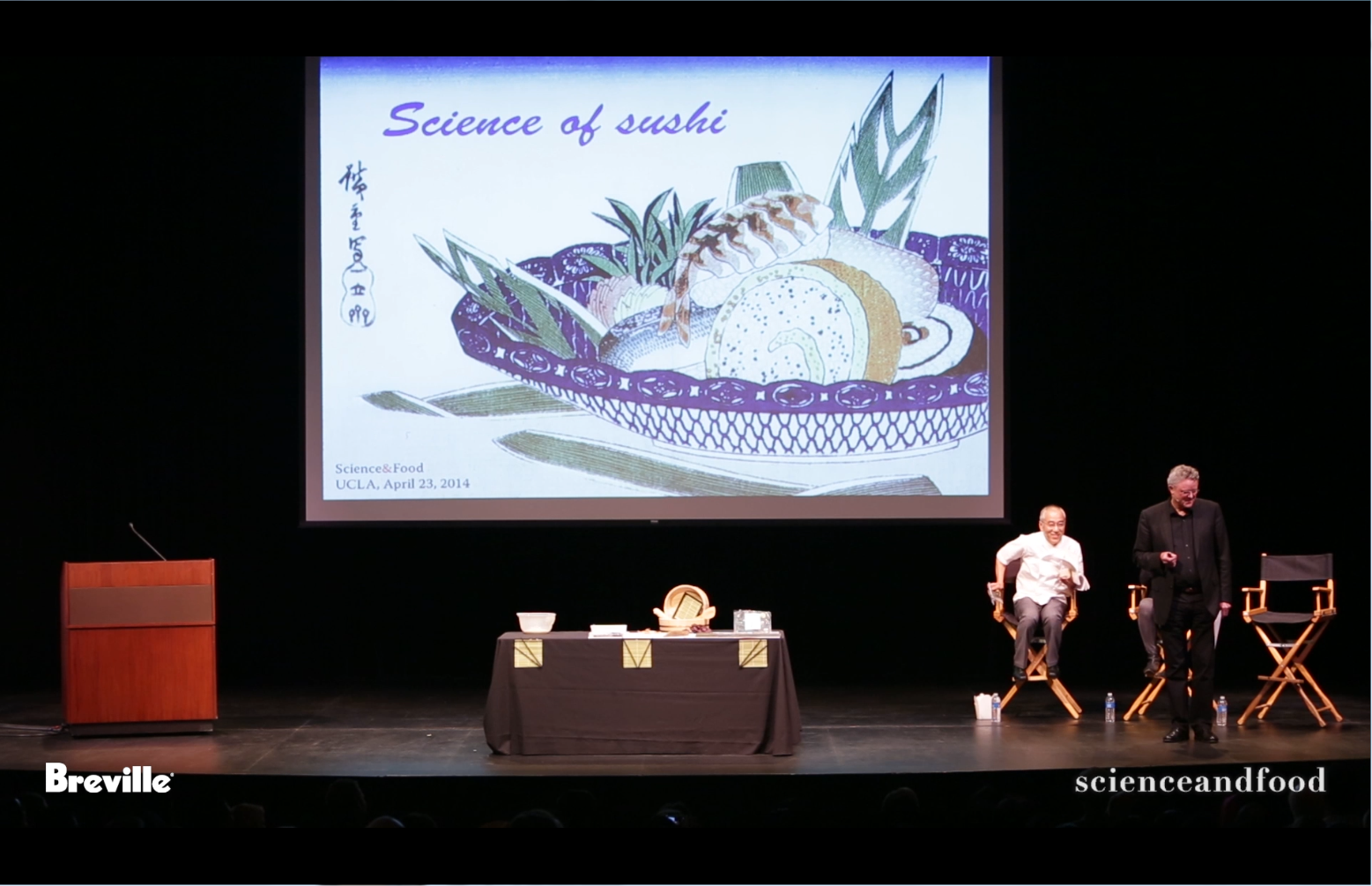
The Science of Sushi

September 16, 2014/in Public Lectures/by Grant Alkin

The Science of Sushi
Featuring Dr. Ole Mouritsen and Morihiro Onodera
April 23, 2014

To kick off our 2014 public lecture series, Dr. Ole Mouritsen joined Chef Morihiro Onodera to satisfy our craving for sushi-related science. The duo explained everything from sushi’s early history to the starchy science of sushi rice. Watch the entire lecture or check out some of the shorter highlights below.

Ole Mouritsen on the history of sushi

“The history of sushi is really the history of preservation of food. . . . Throughout Asia, in particular in China and later in Japan, people discovered that you can ferment fish – that is, you can preserve fish – by taking fresh fish and putting it in layers of cooked rice. . . . After some time the fish changes texture, it changes taste, it changes odor, but it’s still edible and it’s nutritious. And maybe after half a year you could then pull out the fish and eat the fish. That is the original sushi.”

Ole Mouritsen on the science of rice

“If you look inside the rice, you have little [starch] granules that are only three to eight microns, or three t0 eight thousandths of a millimeter, big. . . . When you cook the rice, you add some water and the water is absorbed by the rice and [the granules] swell. And the real secret behind the sushi rice is that when they swell, these little grains are not supposed to break.”

Morihiro Onodera on examining the quality of sushi rice

“First what I do is I soak uncooked rice in water. . . . Sometime after 20 minutes it will start to break. . . . I take a sample to check to see if there are any cracks. . . . With good rice, which has less cracks or breaks, you’re able to feel the texture of each of the grains in your mouth, whereas with the lower quality rice you’re just going to get the stickiness [from the starch].”

https://www.scienceandfood.org/wp-content/uploads/sites/123/2014/09/science-of-sushi-still.png 1005 1557 Grant Alkin https://sites.lifesci.ucla.edu/ibp-scienceandfoodnew/wp-content/uploads/sites/123/2016/09/newlogoSm-2-300x31.png Grant Alkin2014-09-16 10:00:462014-09-16 10:00:46The Science of Sushi
Search Search

Recent Posts

  • Hello world!
  • Hello world!
  • Hello world!
  • Aquafaba Meringues
  • Vertical Farming & Micro-Gardening

Archives

  • March 2017
  • November 2016
  • August 2016
  • May 2016
  • April 2016
  • March 2016
  • February 2016
  • January 2016
  • December 2015
  • November 2015
  • October 2015
  • September 2015
  • August 2015
  • July 2015
  • June 2015
  • May 2015
  • April 2015
  • March 2015
  • February 2015
  • January 2015
  • December 2014
  • November 2014
  • October 2014
  • September 2014
  • August 2014
  • July 2014
  • June 2014
  • May 2014
  • April 2014
  • March 2014
  • February 2014
  • January 2014
  • December 2013
  • November 2013
  • October 2013
  • September 2013
  • August 2013
  • July 2013
  • June 2013
  • May 2013
  • April 2013
  • March 2013
  • February 2013
  • January 2013
  • June 2012
  • May 2012
  • April 2012

Categories

  • Contests
  • Course Lectures
  • DIY Kitchen Science
  • Flavor of the Month
  • News & Views
  • Profiles
  • Public Lectures
  • Science & Food
  • Uncategorized
  • What We're Reading

Meta

  • Log in
  • Entries feed
  • Comments feed
  • WordPress.org
Scroll to top Scroll to top Scroll to top