Science and Food
  • Home
  • Public Events
    • Video Gallery
    • 2022 People, Food, & Climate
    • 2019 Food Waste
    • 2017 Future of Food
    • 2016 Public Lecture Series
    • 2014 Public Lecture Series
    • 2013 Public Lecture series
    • 2012 Public Lecture Series
  • Future Food Fellows
  • Building Community
  • Course
  • Press
  • Support Us
  • Contact Us
  • Click to open the search input field Click to open the search input field Search
  • Menu Menu

Tag Archive for: cheese

Ricotta Cheese

February 12, 2013/in DIY Kitchen Science/by Grant Alkin

Protein networks are responsible for the structure and mechanical properties of many foods such as eggs and meat. Even bread gets its chewy texture from the formation of springy gluten protein networks. As we will see in this recipe, protein network formation is vital for the successful production of cheese. Read more

0 0 Grant Alkin https://sites.lifesci.ucla.edu/ibp-scienceandfoodnew/wp-content/uploads/sites/123/2016/09/newlogoSm-2-300x31.png Grant Alkin2013-02-12 10:00:092013-02-12 10:00:09Ricotta Cheese

Does your cheese taste of microbes?

May 29, 2012/in Course Lectures/by Grant Alkin

In our unit on microbes and exponential growth, we learned about the role of microbes in altering flavor and mouthfeel.  One of our favorite microbial foods is cheese:  Cheese would just be spoiled milk if it were not for microbes.

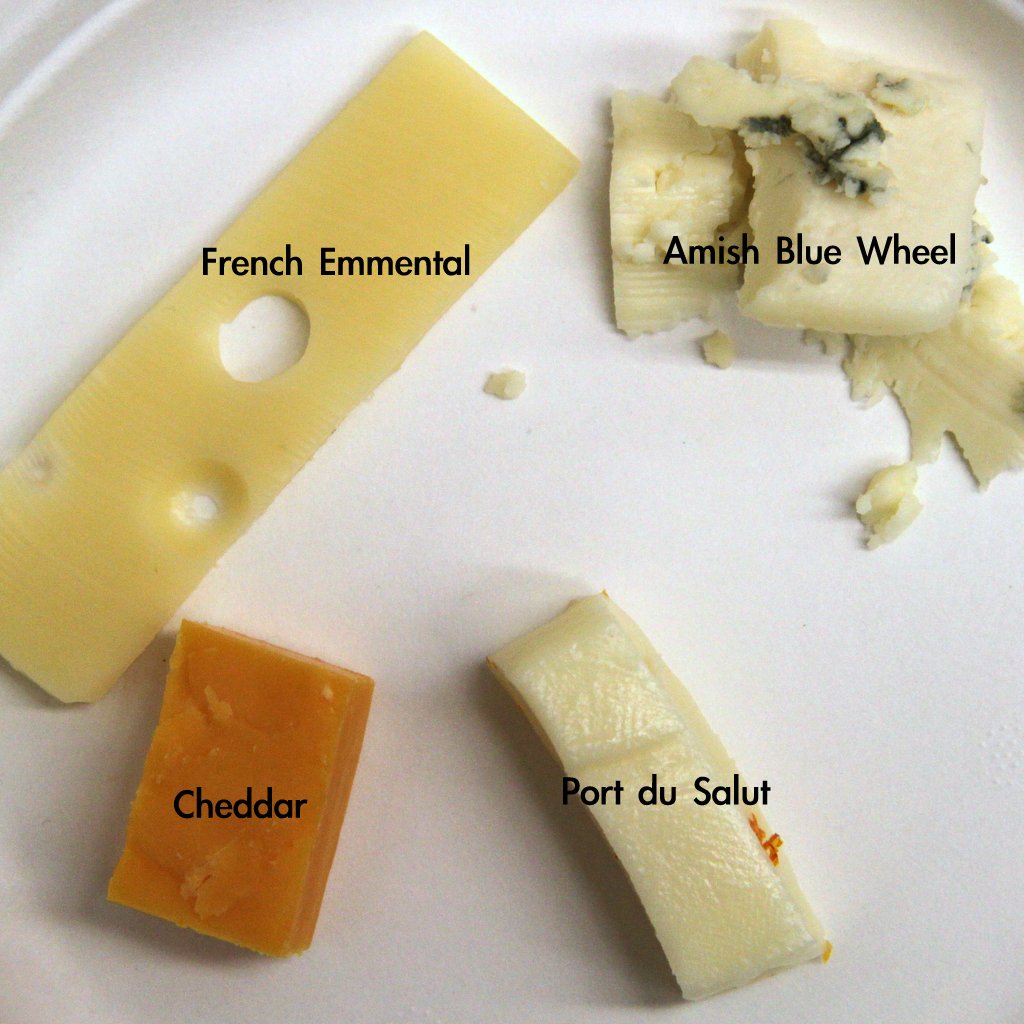
To kick off the class, we challenged the students with a taste test featuring four distinct cheeses:

A) Amish Blue Wheel
B) Emmental
C) Cheddar
D) Port du Salut

We also presented four different types of microbes, and a bit about natural habitats.    Can you guess which microbe belongs to which cheese? Answers below.

1) Propionibacterium (inhabit human skin)
2) Penicillium mold (grow in cool, moderate climate; some species have blue color)
3) Brevibacterium (grow especially well without much personal hygeine)
4) Lactococcus lactis (grow well in acidic conditions)


ANSWERS:

A. 2 – Blue cheeses are inoculated with a strain of Penicillium mold, Penicillium roqueforti. Needles or skewers are used during the inoculation, which is why blue cheeses often have distinct veins running through them.

B. 1 – Emmental is a type of Swiss cheese, which is known for its holes. These holes are bubbles excavated by carbon dioxide, a byproduct of lipid breakdown by Propionibacterium freudenreichii, subsp shermanii. Its close cousin, Propionibacterium acnes, is linked to acne.

C. 4 – Cheddar is an example of a wide variety of cheese types that rely on Lactococcus lactis for the first stage of ripening. L. lactis uses enzymes to produce energy from lactose, a sugar molecule common in dairy products. Lactic acid is the byproduct.

D. 3 – Port du Salut is a washed-rind cheese. The cheese surface is wiped or washed down with a brine that promotes the growth of certain bacteria in the air. A smear of bacteria can be directly applied to the surface to nudge along the process. Brevibacteria linens is commonly used during this inoculation. Ever get a whiff of stinky feet from your cheese? Brevibacteria linens is the culprit, in the cheese and on real smelly feet.

https://www.scienceandfood.org/wp-content/uploads/sites/123/2012/05/img_3222.jpg 1024 1024 Grant Alkin https://sites.lifesci.ucla.edu/ibp-scienceandfoodnew/wp-content/uploads/sites/123/2016/09/newlogoSm-2-300x31.png Grant Alkin2012-05-29 23:10:512012-05-29 23:10:51Does your cheese taste of microbes?
Page 2 of 212
Search Search

Recent Posts

  • Hello world!
  • Hello world!
  • Hello world!
  • Aquafaba Meringues
  • Vertical Farming & Micro-Gardening

Archives

  • March 2017
  • November 2016
  • August 2016
  • May 2016
  • April 2016
  • March 2016
  • February 2016
  • January 2016
  • December 2015
  • November 2015
  • October 2015
  • September 2015
  • August 2015
  • July 2015
  • June 2015
  • May 2015
  • April 2015
  • March 2015
  • February 2015
  • January 2015
  • December 2014
  • November 2014
  • October 2014
  • September 2014
  • August 2014
  • July 2014
  • June 2014
  • May 2014
  • April 2014
  • March 2014
  • February 2014
  • January 2014
  • December 2013
  • November 2013
  • October 2013
  • September 2013
  • August 2013
  • July 2013
  • June 2013
  • May 2013
  • April 2013
  • March 2013
  • February 2013
  • January 2013
  • June 2012
  • May 2012
  • April 2012

Categories

  • Contests
  • Course Lectures
  • DIY Kitchen Science
  • Flavor of the Month
  • News & Views
  • Profiles
  • Public Lectures
  • Science & Food
  • Uncategorized
  • What We're Reading

Meta

  • Log in
  • Entries feed
  • Comments feed
  • WordPress.org
Scroll to top Scroll to top Scroll to top