
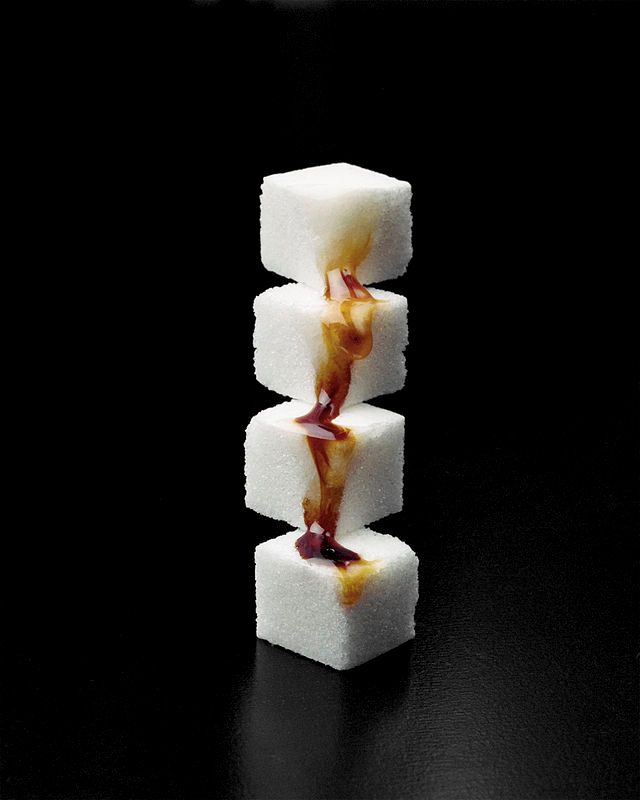
Caramel
Caramel flavor is a major component of desserts and candies, ranging from smooth, thick sauces to crispy, dark brown glazes of crème brûlées. Through caramelization, a browning process where sugar is heated to around 170 °C and broken down, over 100 compounds are formed that contribute to the color, flavors, and textures of what we know as caramel [1].

Photo credit: APN MJM/Wikimedia Commons
One simple way to caramelize table sugar is by heating: this process removes water from the disaccharide sucrose (a substance composed of two simple sugars) and breaks it down into monosaccharides fructose and glucose. Next, the monosaccharides react with each other to form new compounds, such as caramelan, caramelen, and caramelin [2]. These compounds aggregate to form brown particles of various sizes due to additional water elimination, contributing to the characteristic brown color of caramel. The stickiness of caramel can be attributed to the ring form of these molecules combined with the presence of free radicals [3]. Further, when in the presence of alkali, sulphite, or ammonia, these compounds can also result in colorants used in food products such as soy sauce and Coca-Cola [4].
In addition to these classic caramel compounds, many other molecules are produced that result in different aromas that contribute to caramel’s complex flavor profile, such as furans (nutty), diacetyl (buttery), maltol (toasty), and ethyl acetate (fruity) [3].
How to tune the flavor of your caramel? The temperature the sugar is heated to determines caramel flavor. “Light caramel” (180°C) can be used for glazes, is rich in flavor, and pale amber to golden-brown in color. By contrast, “dark caramel” (188-204°C) is dark and bitter in flavor due to increased oxidation of the sucrose molecules; it is usually used for coloring. Additional heating past this point will turn the caramel into a black and bitter mess, as the sugar breaks down into pure carbon [2].
Interestingly, caramel candies made with milk or butter do not undergo the caramelization process. Instead, the heating of the dairy product in the recipe causes Maillard reactions between sugar and amines that result in the brown color and flavors produced [1].
Next time you enjoy caramel flavor, you can revel in the smell and taste of all the aromas that result from complex chemical processes. Or, simply make your own with sugar, water, and a stove.
References Cited
- “Caramelization.” Accessed 21 October 2014.
- “Caramelization.” Accessed 21 October 2014.
- “The Chemistry of Caramel.” ScienceGeist. Accessed 21 October 2014.
- “E150 Caramel.” Accessed 21 October 2014.
 About the author: Catherine Hu is pursuing her B.S. in Psychobiology at UCLA. When she is not writing about food science, she enjoys exploring the city and can often be found enduring long wait times to try new mouthwatering dishes.